
Last checked against the sources listed at the end on 30 September 2026. This is general guidance, not veterinary advice.
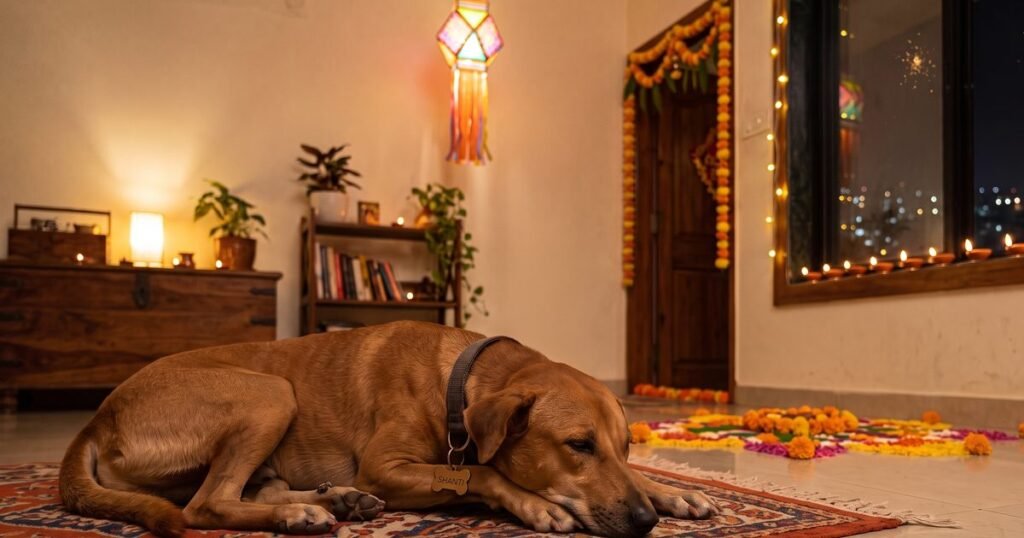
Diwali falls on Sunday, 8 November 2026. For most of us it is the brightest night of the year. For many dogs and cats it is the most frightening: sudden bangs, flashes and the smell of smoke, often for several nights in a row.
The good news is that most of what helps is simple, and most of it has to happen before the first cracker goes off. Here is what to do this week, on the night, and afterwards.
Quick answer: Diwali pet safety in 5 steps
- Put an ID tag with your phone number on your pet’s collar before Diwali.
- Walk your dog early, before dark, on a leash, and bring them in before the crackers start.
- Keep pets indoors in a quiet room with windows closed and a TV, radio or fan on to mask the noise.
- Don’t share mithai, chocolate, kishmish, sugar-free sweets or namkeen. Several are toxic to dogs and cats.
- If your pet panicked last year, talk to your vet at least a week before Diwali. Never give human medicine.
Signs your pet is scared
Fear does not always look like barking. Watch for trembling, hiding in odd but quiet places (under the bed, in a cupboard, in the bathroom), pacing, drooling and clinging to you [S1]. A frightened animal may try to run, jump from a balcony or squeeze through a gate, and while panicking it may bite, even someone it loves [S1].
This week: prepare before the noise starts
- Put an ID tag on the collar with your phone number. If your dog or cat bolts, a tag is the fastest way home.
- Take a clear, recent photo of your pet from the front and the side. If they go missing, this is the first thing you will need.
- Check the escape routes: gaps in gates, balcony railings, loose window nets and the main door when guests come and go.
- Pick a safe room now, ideally one with few windows, and let your pet get used to resting there with their bed, water and a familiar blanket.
- If your pet panicked last year, talk to your vet at least a week before Diwali. Vets can advise on options for known stressful events and may want to test them beforehand [S1]. Please don’t give any human or leftover medicine on your own.
- Check vaccinations are up to date, especially rabies. A frightened animal is more likely to bite or be bitten. Our free Pet Vaccination Tracker shows what is due.
On Diwali night
- Walk your dog early, before dark and before the crackers start, and keep the leash on. Check the collar is snug enough that your dog can’t back out of it if a cracker goes off nearby.
- Keep your pet indoors in the safe room, with windows closed and curtains drawn. A TV, radio or fan helps cover the noise [S1].
- Stay home if you can, or make sure someone your pet knows is there.
- Let them hide. If your dog wants to be under the bed, let them. Don’t pull them out or scold them for being afraid.
- Keep cats indoors from the evening before until the morning after, with somewhere high or enclosed to hide.
- Keep lit diyas, candles and rangoli colours out of reach. Wagging tails and curious paws are quick.
Festive food: what not to share
Diwali means boxes of mithai, dry fruits and namkeen everywhere. Several common ingredients are harmful to dogs and cats [S2]:
- Chocolate can cause vomiting, diarrhoea, a racing heart, tremors and seizures, and can be fatal.
- Raisins and grapes (kishmish in mithai and dry-fruit boxes) can cause kidney damage.
- “Sugar-free” sweets may contain xylitol, which can cause dangerously low blood sugar and liver damage.
- Onion and garlic, common in namkeen and festive snacks, can damage red blood cells.
- Fried and fatty food can cause vomiting, diarrhoea and, in some pets, pancreatitis.
- Salty snacks, alcohol and bones from party leftovers are also on the list [S2].
Ask guests not to feed your pet, and keep gift boxes off low tables. If you think your pet has eaten something harmful, call your vet straight away rather than waiting for symptoms.
Street dogs and cats in your colony
- Feed them early in the evening and leave water out. Frightened animals often won’t come out to eat later.
- Don’t burst crackers near sleeping or resting animals, and ask children to keep a distance from them.
- If you see anyone tying crackers to an animal or throwing them at one, speak up. Deliberately harming an animal this way is cruelty under the Prevention of Cruelty to Animals Act, 1960.
- Check under parked cars and in drains the next morning for animals that hid overnight and may be hurt. For an injured animal, contact a local animal rescue group or your municipal animal helpline.
If your pet runs away
- Search immediately and close to home. Frightened pets usually hide nearby: stairwells, parking basements, under cars, behind generators.
- Tell your guards and neighbours, and share the photo in your RWA and local pet groups with your phone number.
- Go out again when it is quiet, late at night or early morning, and call softly. Many pets come out only once the noise stops.
- Call local shelters and rescue groups the next day in case someone has picked your pet up.
What about the firecracker rules in my city?
Rules on which crackers are allowed, and at what times, change every year and differ by state and city. In Delhi-NCR they are usually decided in October. Check your state government’s or city’s order for 2026 before Diwali rather than relying on last year’s rules.
Keep your pet’s details in one place. A free Pet Passport holds your pet’s photo, vaccination records and documents, so they’re on your phone if you ever need to show them to a vet, a shelter or a neighbour.
Frequently asked questions
When is Diwali in 2026?
Diwali (Lakshmi Puja) falls on Sunday, 8 November 2026. Crackers often start a few days before and continue for a night or two after.
How do I calm my dog during Diwali crackers?
Walk your dog before dark, then keep them indoors in a quiet room with windows closed and curtains drawn. A TV, radio or fan helps mask the noise. Let your dog hide if they want to and don’t scold them for being afraid.
Can I give my dog medicine to calm down on Diwali?
Only if your vet prescribes it. If your dog panicked during previous Diwalis, speak to your vet at least a week before, so any option can be tested beforehand. Never give human medicine or leftover tablets on your own.
Which Diwali sweets and snacks are dangerous for dogs and cats?
Chocolate, raisins (kishmish), grapes, sugar-free sweets containing xylitol, onion and garlic in namkeen, and fried, fatty or salty snacks can all harm pets. If you think your pet ate something harmful, call your vet straight away.
What should I do if my dog runs away during Diwali?
Search immediately close to home: stairwells, parking basements and under cars. Tell your guards and neighbours, share a recent photo in RWA and local pet groups, and go out again when it is quiet. The next day, call local shelters and rescue groups.
How can I help street dogs and cats during Diwali?
Feed them early in the evening and leave water out, don’t burst crackers near resting animals, and check under cars the next morning for animals that may be hurt. Deliberately harming an animal with crackers is cruelty under the Prevention of Cruelty to Animals Act, 1960.
Sources and last checked
- [S1] Cornell University College of Veterinary Medicine, Fireworks fears? Tips to protect your pets. Last checked: 30-09-2026.
- [S2] ASPCA Animal Poison Control, People foods to avoid feeding your pets. Last checked: 30-09-2026.
PawsitiveHoomans is not a veterinary service. If your pet is unwell, injured or has eaten something harmful, contact a veterinarian.