
Last checked against the sources below on 20-10-2026. First aid is not a substitute for a veterinarian.
If you feed or rescue street animals, sooner or later you’ll find one hurt. A small kit and a few rules can keep the animal stable, and you safe, until a vet takes over. This guide is based on the American Veterinary Medical Association’s (AVMA) pet first aid advice, adapted for street animals. For more on caring for dogs, visit our dog hub.
Rule one: protect yourself
- An injured animal may bite or scratch, even one that’s normally gentle. Never assume it won’t. [S1]
- Don’t hug an injured animal or put your face near its mouth. [S1]
- A muzzle, or a strip of gauze used as one, prevents bites, but never muzzle an animal that is vomiting. [S1]
- For street animals especially, wear gloves. If you’re bitten or scratched, wash the wound with soap and running water and see a doctor about rabies shots the same day.
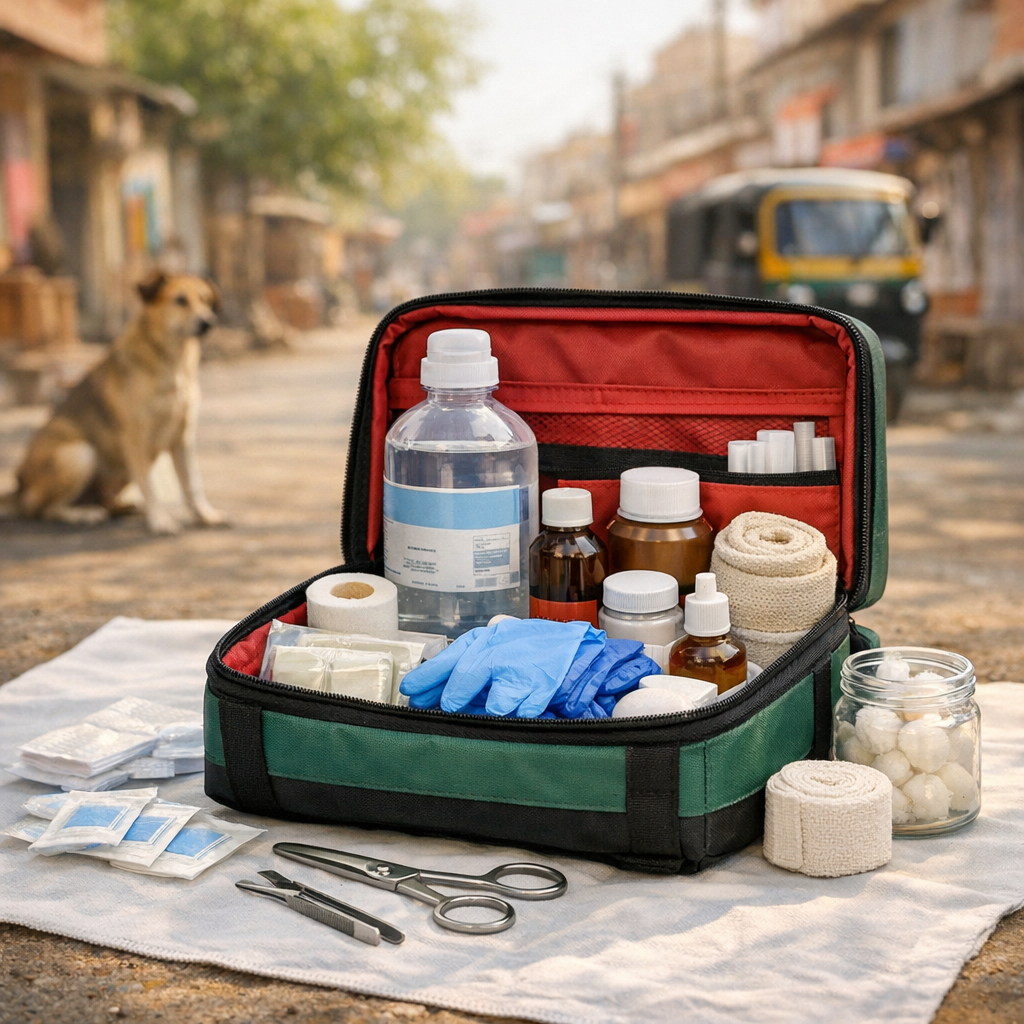
What to keep in the kit
From the AVMA’s checklist: [S1]
- important phone numbers: your vet, an emergency clinic, poison control and animal control
- a digital thermometer
- a muzzle
- a spare leash and collar
- a gauze roll, for wrapping wounds or as an emergency muzzle
- clean towels, for restraining cats, cleaning or padding
- non-stick bandages or strips of clean cloth
- self-adhering non-stick tape, and adhesive tape
- a large syringe without a needle, or an eye dropper, to flush wounds
- saline solution for cleaning wounds (contact-lens saline works) [S1]
- a pet carrier, for cats and small dogs
Add for street work: disposable gloves, a torch, a sturdy cardboard box with air holes for cats or puppies, and a bottle of drinking water.
How to stop bleeding
- Press directly on the wound with a clean towel or cloth for at least 3 minutes before checking. [S1]
- If blood soaks through, add more cloth on top; don’t remove the soaked layer, as that disturbs clotting. [S1]
- Severe bleeding needs a vet immediately. [S1]
How to move an injured animal
- Confine the animal in a small space to stop it injuring itself further: a carrier, or a box with airflow. [S1]
- For a large dog, use a board, blanket or something similar as a stretcher. [S1]
- Call the clinic before you set off, so they can prepare. [S1]
What NOT to do
- Don’t give any medicine, including human painkillers, unless a vet tells you to. [S1] Common human painkillers can be poisonous to dogs and cats.
- Don’t make an animal vomit unless a vet or poison helpline tells you to. [S1]
- Don’t pour hydrogen peroxide on wounds. [S1]
- Don’t feed or give water to an animal that may need surgery, unless the vet says it’s fine.
- Don’t skip the vet. Any first aid should be followed by immediate veterinary care. [S1]
The Pawsitive Hoomans Take
The most useful item in your kit isn’t a bandage; it’s a list of phone numbers. Save your nearest vet, an emergency clinic and your city’s animal helpline today, and keep a sturdy box and a towel in your bike or car.
🐾 Looking after community dogs? Keep each one’s vaccination and treatment record in a free Pet Passport, and use the Vaccination Tracker for their yearly rabies shot.
Related: how to file an FIR for animal cruelty in India.
Frequently asked questions
What should be in a first aid kit for street dogs?
Gauze, non-stick bandages, tape, saline, clean towels, a muzzle, a spare leash, a thermometer, a syringe for flushing wounds and emergency phone numbers. [S1] For street animals, add gloves.
Can I give paracetamol to an injured dog?
No. Don’t give any medicine unless a vet tells you to. [S1]
How do I stop a street dog’s wound bleeding?
Press firmly with a clean cloth for at least 3 minutes; add layers rather than removing soaked ones, and get to a vet. [S1]
How do I safely carry an injured dog?
Use a board or blanket as a stretcher, after calling the clinic ahead. [S1]
Sources and last checked
- [S1] American Veterinary Medical Association, Pet First Aid (client brochure and first aid kit checklist) – avma.org (PDF) – Last checked: 20-10-2026
Disclaimer: PawsitiveHoomans is an independent information resource and is not affiliated with the AVMA. First aid does not replace veterinary care; take an injured animal to a vet as soon as possible.